
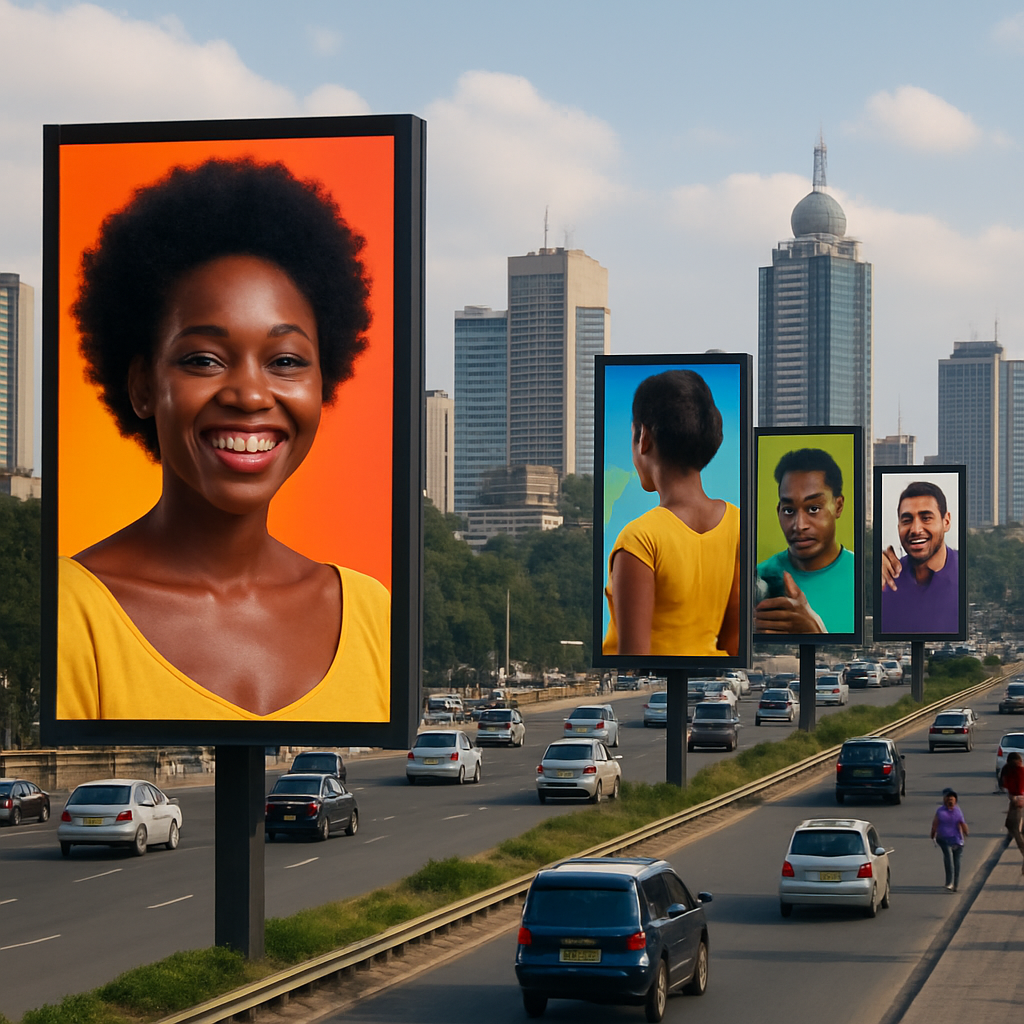
Walk through Lagos at dusk or ride the Red Line in Cairo at rush hour and you’ll see it: immense LED canvases pulsing with color, hyper-local offers that refresh with the weather, QR codes that whisk passersby into WhatsApp chats, and countdowns synchronized to e-commerce flash sales. Digital billboards in Africa’s largest cities are no longer mere signage; they are nodes in a connected marketing system, aligning offline spectacle with online precision. This convergence is reshaping how brands plan, buy, and measure reach across the continent’s fastest-growing urban centers.
Market momentum in Africa’s urban engine rooms
Africa’s metropolitan corridors—Lagos, Johannesburg, Nairobi, Cairo, Accra, Abidjan, Casablanca—are expanding at unprecedented speed. The United Nations has long projected that the continent’s urban population will at least double by mid-century, compressing millions of daily journeys into dense transit and retail hubs where attention is both scarce and intensely valuable. This density is the oxygen for digital billboards, which monetize high-traffic intersections, malls, and transit interchanges with dynamic content that changes by hour, by event, and by demand.
On the demand side, the shift to connected screens dovetails with a mobile-first internet economy. GSMA forecasts have consistently pointed to accelerating smartphone adoption in Sub-Saharan Africa, crossing the 60% mark around the middle of the decade, and bringing with it behaviors—social video, mobile wallets, super-apps—that reward quick, contextually relevant calls-to-action. In parallel, the region leads the world in mobile money usage; hundreds of millions of registered accounts and billions in monthly transactions turn an on-street prompt into a near-instant purchase or signup on a handset. The billboard and the browser, the street and the scroll, now work in lockstep.
Global out-of-home has also swung digital. Industry trackers frequently note that digital out-of-home—often shortened to DOOH—has been expanding at double-digit rates post-pandemic, and its share of overall OOH spend has climbed steadily, approaching or surpassing two-fifths in many mature markets. African markets are smaller but accelerating: while digital’s share of OOH varies widely by city and by operator, major corridors in South Africa, Egypt, Nigeria, Kenya, and Morocco have seen fast rollouts in the last five years, with a concentration of high-brightness roadside LED, mall networks, and transit screens.
Hardware, networks, and the new supply map
The old OOH map prized location above all else. The digital map still worships location, but it adds pixel density, refresh rate, data connectivity, and remote control. Operators now track uptime in real time, stitch together citywide networks, and deliver synchronized content across dozens or hundreds of sites in seconds. In Lagos, landmark LED walls flank the highways funneling commuters onto the Third Mainland Bridge. Johannesburg and Sandton hub screens beam premium retail content to shoppers and office workers. Nairobi’s Waiyaki Way and Thika Superhighway host roadside LED arrays, while matatu and BRT stations multiply touchpoints. Cairo’s Ring Road and 6th of October Bridge host immense canvases that pivot content based on traffic conditions.
Power reliability and connectivity are persistent concerns, so media owners have leaned into hybrid energy (grid plus solar or battery backups) and redundant 4G/5G links. Ruggedized chassis, anti-glare coatings, and remote diagnostics keep screens alive through heat, dust, and rain. This operational backbone turns a disparate set of sites into a manageable, marketable inventory that agencies can plan by reach, frequency, context, and proximity to key points of interest.
Another shift: place-based networks. Beyond roadside LEDs, advertisers increasingly value high-dwell-time environments—malls, cinemas, gyms, airports, fuel stations, medical centers, and university campuses—where screens can carry longer-form storytelling or interactive prompts. These networks often support standardized creative specs and dynamic templates, accelerating campaign turnaround and reducing production friction across cities and countries.
Where internet marketing meets the street
Digital billboards in Africa are not a siloed medium; they are connectors across the marketing funnel. Upper-funnel fame—eye-catching, culturally tuned, locally relevant—meets mid- and lower-funnel performance when screens trigger mobile behaviors. That bridge is practical as well as psychological: campaign creatives routinely feature QR codes, short URLs, and chat-based calls-to-action that land the audience in WhatsApp, Instagram DMs, or merchant checkouts powered by M-Pesa, Flutterwave, Paystack, or Fawry.
On the planning side, brand teams now design city flighting the way they schedule digital video—dayparted bursts, event-driven takeovers, and live updates pulled from feeds. Game days, concert nights, payday weekends, and e-commerce festivals become anchors for synchronized content drops. Social content often piggybacks: an influencer collaboration runs on TikTok and Instagram Reels, and the best frames are ported to LED walls in the target neighborhoods within hours, building a feedback loop between social proof and real-world presence.
Crucially, buying has shifted from month-long loops to data-driven, flexible windows. While classic in-advance bookings remain common, agencies are increasingly testing programmatic pipes: systems that let them buy impressions or time slices across multiple operators with algorithms optimizing delivery by location, audience density, or weather triggers. Programmatic buying also enables retargeting segments: those exposed to an on-street ad can be reached later on mobile display or social, stitching offline exposure to online conversion with responsible data handling.
Data, targeting, and privacy-by-design
Digital billboards cannot target individuals the way a web cookie does, but they can adapt based on context and probabilistic audience models. Traffic density, GPS-based movement patterns, weather, point-of-interest proximity, and time of day inform content rotation. A breakfast promo plays from 6–10 a.m. near transit hubs, a ride-hailing discount triggers when it rains, and a fintech onboarding message rotates near universities at the start of term. Location intelligence platforms help planners pick screens where likely audiences pass repeatedly within a campaign window, maximizing opportunities for effective frequency.
For more precise activation, planners may draw virtual perimeters around retail clusters or commuter corridors and link screen plays to mobile engagement, a tactic commonly called geofencing. Done well, this approach focuses media where it’s most likely to move feet into stores or clicks into carts. Done poorly, it risks waste or privacy overreach. Regulations matter: South Africa’s POPIA, Nigeria’s NDPR, Kenya’s Data Protection Act, Egypt’s data rules, and pan-African cross-border guidance all shape how location data and device identifiers can be used. Effective operators and agencies lean into consented, aggregated, and anonymized datasets, secure processing, and transparency in methods.
Triggers add another layer of relevance without compromising privacy: screens can swap content based on real-time data feeds—weather, pollen counts, traffic jams, sports scores, currency moves, or inventory status in nearby stores. These triggers are contextual rather than personal, offering a sweet spot between relevance and compliance.
Buying models, pricing logic, and economics
Digital OOH can be bought in several ways. Traditional models sell share-of-voice on a loop—e.g., a 1-in-6 slot on a 60-second rotation for a set number of weeks. Time blocks are common for takeovers around events. Increasingly, buyers also transact on impression-based frameworks: estimated eyes-on or presence-adjusted exposures using traffic counts, sensor data, and predictive models. In hybrid markets, media owners may quote both a fixed fee and an equivalent CPM to help digital teams compare options with other channels.
Indicative pricing varies widely. Roadside LEDs on major arteries in Lagos, Johannesburg, Cairo, and Nairobi command premiums, while secondary roads or place-based screens price lower. When bought via impression-led or programmatic systems, mid-range roadside placements can translate to single-digit USD CPMs, with prime airports or iconic wraps costing more. Supply and demand drive seasonality: December holidays, back-to-school, Eid, or national shopping festivals can tighten availability and lift rates. For direct buys, brands should pressure-test: audited reach estimates, dwell-time assumptions, and viewable area free from obstructions, then translate to performance goals like store visits or lead volume.
Programmatic pipes add flexibility: pause-and-play controls during unforeseen events, dynamic pricing during off-peak hours, and cross-operator packages assembled in real time. They also introduce familiar digital concepts—frequency caps at the screen level, audience segment overlays, and connectable KPIs in unified dashboards—helping OOH teams speak the same language as their digital counterparts.
Creative that earns attention and action
Digital billboards reward simplicity married to precision. The most effective creatives exploit scale and motion but keep cognitive load low: a dominant visual, a five-to-seven-word headline, a single clear CTA. Fonts and contrast must survive glare and motion; brand colors should pop against the city’s ambient palette. For performance, pair a scannable QR code with a short memorable URL and, when relevant, a WhatsApp deep link; many consumers find chat-based flows more natural than web forms.
Dynamic content is the real unlock. Template-driven variations let marketers localize by neighborhood, time, or trigger: “20% off, today only, Yaya Centre” versus “Free delivery to Lekki Phase 1.” Real-time feeds turn static awareness into utility: a ride-hailing ETA and discount near stadium gates post-match; a loan product with indicative APR only during office commute hours; a food delivery ad that surfaces the most-ordered dish when a mall’s footfall spikes. Cinematic flourishes—anamorphic 3D illusions, synchronized multi-screen takeovers—can dominate social chatter, but they work best when tethered to a frictionless path to action.
Language and culture remain decisive. Multilingual creative rotations—Arabic and English in Cairo, Kiswahili and English in Nairobi, isiZulu/isiXhosa and English in Johannesburg, Pidgin and English in Lagos—signal respect and relevance. Local humor, familiar landmarks, and micro-seasonal cues (school reopening weeks, derby days, harvest festivals) amplify resonance.
From exposure to outcomes: proving impact
Marketers increasingly expect OOH to answer the same questions as digital: who saw it, what did they do, and how much incremental value did it add? While on-street impressions are modeled rather than individually observed, sophisticated measurement frameworks combine multiple signals: audited traffic counts and pedestrian flows, mobile panel data for presence verification, store-visit studies using consented location samples, brand-lift surveys delivered through mobile, and econometric models that isolate the medium’s contribution in multichannel mixes.
For performance campaigns, the holy grail is attribution that connects exposure to action with statistical rigor and privacy safeguards. Common approaches include:
- Footfall lift: Compare store or branch visits among devices commonly present near screens during play windows versus matched controls in similar areas without exposure.
- Web or app lift: Track spikes in direct traffic, search queries, or app installs within catchment zones and time windows, controlling for other media and promotions.
- Sales match: In markets where retailers share anonymized transaction data, model incremental sales near exposed zones relative to controls.
- Marketing mix modeling: For brands with large budgets and historical data, MMM quantifies OOH’s ROI across cycles, informing optimal spend shares.
Expectations should be realistic. On-street exposures do not produce click-throughs, and attribution analyses rely on modeled probability and panels. That said, well-structured studies routinely demonstrate significant lifts in store visits, branded search, and assisted conversions when DOOH is layered into social, video, and search plans—especially when the creative explicitly names neighborhoods, limited-time offers, or triggers a next step via QR or chat.
Illustrative scenarios from African cities
Fintech onboarding in Lagos
A challenger fintech times a week-long takeover across 25 high-traffic LEDs in Victoria Island, Lekki, and Ikeja during salary week. The creative rotates localized CTAs—“Zero-fee transfers, today in Lekki”—with QR codes into a WhatsApp KYC flow. Weather triggers boost ride-hailing cashback messages when rain slows commutes. Mobile retargeting engages devices seen near the screens within four hours of exposure. Outcomes: a measurable lift in branded search, a spike in verified sign-ups in the targeted LGAs, and improved cost per verified user versus social-only flights.
Grocery e-commerce in Nairobi
An online grocer runs road-side and mall screens near Westlands, Kilimani, and along Thika Road. Dynamic feeds show “1-hour delivery to Parklands” and “Fresh tilapia, 15% off today.” The QR code lands users in a pre-filled cart based on the most-ordered items in that neighborhood. Place-based rotations inside malls run longer-form recipe videos over weekends. Concurrently, search ads bid on “grocery delivery near me,” and social ads highlight the same offer art to maintain visual continuity. Results include uplift in new user cohorts around the targeted malls and increased repeat orders when the ad copy calls out neighborhood names.
Automotive launch in Cairo
A car brand unveils a new SUV with synchronized content across the Ring Road and 6th of October Bridge, timed with a live-streamed reveal. Real-time traffic data dictates when performance footage runs (light traffic) versus static product beauty shots (heavy jams). A mall-based VR test drive booth mirrors the outdoor content and collects leads via mobile number. The combined campaign produces higher-than-expected test-drive bookings and a sustained lift in dealership visits within the designated catchment areas.
Barriers, risks, and how leaders mitigate them
Infrastructure challenges persist. Power fluctuations can black out screens; robust UPS systems, solar augmentation, and remote monitoring reduce downtime. Connectivity hiccups can delay content pushes; dual-SIM routers and cached playlists keep rotations stable. Environmental wear—heat, dust, humidity—demands rugged hardware and preventive maintenance.
Regulatory and reputational risk also matter. City authorities may adjust content guidelines, brightness limits, and operating hours; proactive compliance and community engagement help. Content appropriateness varies by locale; brands should pre-vet sensitive themes and avoid panic-triggering creative near congested intersections. Data practices must align with national laws and operator codes; trust is a competitive advantage as consumers and regulators scrutinize location-based tactics.
Operational fragmentation remains a headache. Many African cities host dozens of independent operators, each with unique specs, booking systems, and reporting methods. Consolidators and supply-side platforms help, but buyers should demand standard creative specs, proof-of-play logs, third-party verification where available, and clear make-good policies for downtime.
What’s next: formats, standards, and the hybrid journey
The near-term roadmap points to denser networks, smarter triggers, greener power, and more immersive spectacles. Expect more 3D anamorphic creative on landmark sites, but also a proliferation of human-scale screens near point-of-sale where dynamic price and product feeds can drive immediate conversion. Sensor fusion—pulling in weather, mobility, and event APIs—will make content orchestration more adaptive.
On the systems side, the industry is marching toward greater interoperability: harmonized creative specifications, shared taxonomies for locations and venue types, and APIs that let brands plan, buy, and measure across multiple operators in a single flow. As data clean rooms and privacy-first audience modeling mature, cross-media frequency and reach planning will become more accurate, allowing marketers to cap waste and optimize for incremental exposure rather than blunt repetition.
Finally, sustainability will climb the agenda. Energy-efficient panels, solar augmentation, and responsible e-waste practices will differentiate premium partners. Cities will increasingly ask operators to contribute to public value—wayfinding, civic alerts, small business spotlights—strengthening the social license to operate.
A practical playbook for marketers
- Clarify the role of digital billboards in your funnel: fame, consideration, store visits, or direct response via QR/chat. Tie each role to distinct KPIs.
- Map your audience journeys by neighborhood and time of day. Align screen selection to real commuter paths and retail gravity, not only to vanity landmarks.
- Design modular creative templates for rapid localization and data-driven swaps. Keep copy short, contrast high, and CTAs obvious.
- Use contextual triggers judiciously: weather, events, and dayparts that truly change purchase intent.
- Anchor your plan with a blended buy: direct placements for must-have icons plus impression-led or programmatic bundles for flexible reach and optimization.
- Negotiate transparency: proof-of-play logs, audited reach estimates, downtime policies, and third-party verification where feasible.
- Build the bridge to mobile: QR to WhatsApp or a pre-filled cart, retarget exposed zones on social, and sync creative assets across channels.
- Pre-register your attribution and lift methodology. Agree on windows, catchment radii, and control groups before launch.
- Respect privacy and local norms. Favor aggregated, consented data and clearly separate contextual triggers from personal targeting.
- Iterate weekly. Swap underperforming copy, test neighborhood-specific value props, and adjust rotations to live performance.
Why this wave matters
Digital billboards are redefining what African cities look and feel like, but more importantly, they’re redefining how marketing works in places where mobile is the default screen and the street is the default stage. The winners will be brands and operators who think systemically: big ideas calibrated to crowded commutes, precise context informing dynamic content, and closed-loop learning that translates real-world exposures into measurable business outcomes. When the sparkle of LED meets the discipline of internet planning, cities become omnichannel canvases—and attention turns into action, block by block.